
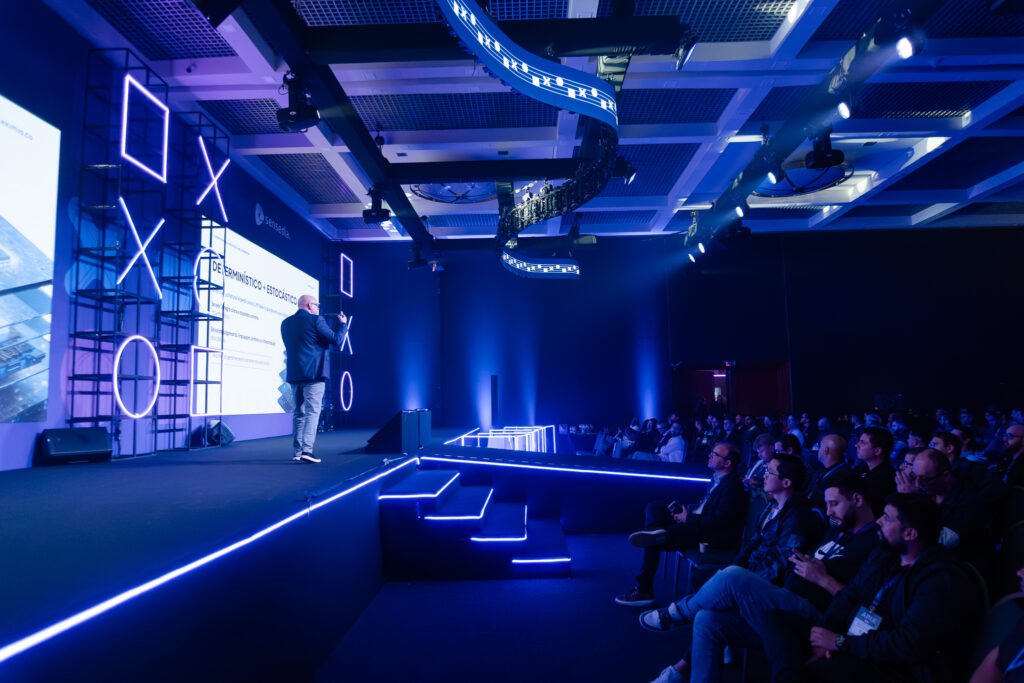
Choosing an event venue for large events involves much more than checking how many people a space can accommodate. After all, large-scale events require different operational elements, including infrastructure, technology, circulation, catering, safety and service.
Therefore, before booking a venue, organizers need to assess whether its infrastructure can support the event’s requirements. After all, a large capacity alone does not guarantee efficient operations or a positive attendee experience.
Capacity is not the only factor
A venue may accommodate thousands of people and still have limitations for certain event formats. In this context, it is important to understand how the venue distributes attendees and which spaces it offers for each stage of the program.
For example, a congress may require a plenary room, breakout rooms, registration areas, sponsor spaces, catering and networking areas. In this way, organizers can assess the venue more comprehensively instead of focusing only on the size of the main hall.
In addition, flexible spaces make it easier to adapt different layouts according to the profile and objectives of each event.
What are the risks of inadequate infrastructure?
One of the first challenges can involve attendee circulation. Limited access points, long lines and small common areas can make movement more difficult and affect the overall experience.
Likewise, limited audiovisual infrastructure can interfere with presentations, talks and live broadcasts. For this reason, equipment and technical support need to match the event’s size and requirements.
Catering also deserves attention. At large events, coffee breaks, meals and beverages require careful planning of space, flow and staff. When the infrastructure cannot support this demand, lines and delays can affect the schedule.
Logistics should be part of the decision
Large events involve suppliers, technical teams, speakers, guests and attendees. Therefore, the venue needs to facilitate material deliveries, setup, dismantling and team circulation.
Moreover, signage and accessibility contribute directly to a more organized journey. Clear information and well-defined routes help attendees find meeting rooms, restrooms, catering areas and other facilities.
In this context, location also matters. Easy access, transportation options and parking availability can influence the attendee experience even before the event begins.
What should you assess before choosing?
Before booking an event venue for large events, consider:
- Capacity and room layouts;
- Audiovisual and technology infrastructure;
- Circulation and access points;
- Catering and networking areas;
- Technical and operational support;
- Accessibility;
- Setup and dismantling infrastructure;
- Signage and wayfinding;
- Location, transportation and parking.
As a result, the decision takes the entire event journey into account rather than focusing only on venue capacity.
Infrastructure for large events at WTC Events Center
WTC Events Center offers flexible spaces and infrastructure for different event formats and sizes. As a result, its variety of environments allows organizers to combine plenary rooms, breakout spaces, common areas, catering and other requirements within the same complex.
In addition, the connection with Sheraton São Paulo WTC Hotel expands the possibilities for events that also require accommodation and complementary services.
Finally, choosing the right event venue for large events from the planning stage helps reduce risks and creates better conditions for execution. At large-scale events, prepared infrastructure contributes directly to operational efficiency and the attendee experience.